
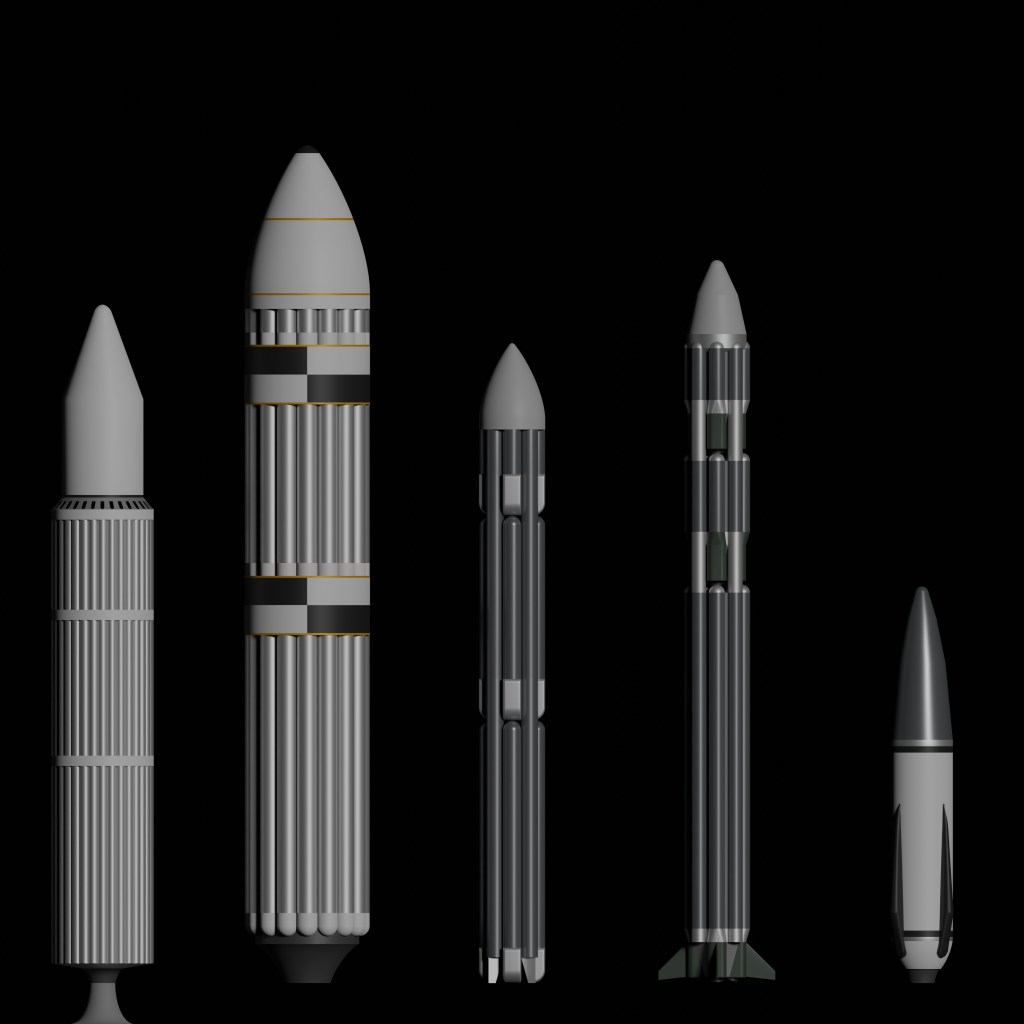
This article presents a review of the “Soldier Warfighter Operationally Responsive Deployer for Space” (SWORDS) and similar vehicles developed at least in part by KT Engineering with novel modular nozzle and propellant tank design configurations.

Animation by Fuzzy Aerospace depicting, from left to right, MPLS, RSLV-S, the 2012 design of SWORDS, the 2013 design of SWORDS, and ARISE.
Nomenclature
AFRL – Air Force Research Laboratory
ARISE – Aerospike Rocket Integration and Suborbital Experiment
ARMR – Affordable Responsive Modular Rocket
DARPA – Defense Advanced Research Projects Agency
FALCON – Force Application and Launch from CONtinental united states
GNC – Guidance, Navigation, and Control
JCTD – Joint Capability Technology Demonstration
KSC – John F. Kennedy Space Center
KTE – KT Engineering of Alabama, United States of America
LEO – Low Earth Orbit
Methalox – methane and oxygen propellant
MPLS – Mass Producible Launch System
MSFC – Marshall Space Flight Center
OSD – Office of the Secretary of Defense
RSLV – Radially Segmented Launch Vehicle
SMDC – US Army’s Space and Missile Defense Command
SWORDS – Soldier Warfighter Operationally Responsive Deployer for Space
TBE – Teledyne Brown Engineering
Mass Producible Launch System


Pages from Sisk’s patent [1].
In 1997 a patent for a mass producible launch system or MPLS was filed, written by David S. Sisk, at the time an employee of Lockheed Martin who worked on structural engineering for Centaur stages [1, 2]. The MPLS would be assembled of multiple elements such as engines, tanks, and structural elements to be produced by separate competing suppliers to drive down cost. Modularity provided by a segmented design, of clustered wedge shaped propellant tanks and small combustion chambers, would allow the launch system to scale up and down as the payload required.
The MPLS would have a central cavity, which in flight may act as a sc/ramjet, that an extendable central umbilical tower with electrical, fluid, and other interfaces would enable transfer between the MPLS and the ground service equipment. Clustered combustion chambers would create the outside primary flow of a toroidal aerospike nozzle, with interior secondary gas exiting the base of the aerospike being generated by the central sc/ramjet that becomes a rocket engine later in the flight, being inspired by concepts published by David Haung [3]. Said clustered combustion chambers would be slightly canted to allow for orientation control through differential throttling.
Propellant was to be stored in 10 to 500 wedge or pie-slice shaped tanks forming a circular structure, with welded steel being singled out as a potential low cost option. The monocoque skin and central spine of the MPLS would maintain structural integrity, at least when on the ground and empty, without pressurization. Tanks would maintain pressure in flight either by being filled with gas regulated from high pressure bottles or a fraction of main propellants being pumped, going through a heat exchanger, and entering the tanks as heated gas.
Radially Segmented Launch Vehicle
Around 2001 KT Engineering or KTE was founded [4]. At least by 2003 KTE was developing a family of small 1814 kg, medium 13607 kg, and large 45359 kg to orbit payload RSLV versions [5]. The same year KTE was selected by DARPA for Phase 1 of their Small Launch Vehicle “FALCON” task to develop a concept for getting at least 454 kg payload into LEO for less than $5,000,000 sans integration costs [6].
KTE tested methalox engines from 2005 to 2007 at MSFC and spark and catalytic torch igniters at Purdue University from 2006 to 2008 [7]. Efficient and stable combustion was demonstrated over a variety of mixture ratios and from 100% to 60% throttle of rated thrust. In April of 2006 an engine rated to produce 89 kN in vacuum was fired for 103 seconds from Air Force funding [8, 9, 10].


Tests of engines and igniters [2, 11].
A 33 kN methalox engine was also tested, though unclear if it was at MSFC or Purdue University as a part of developing an engine for a crewed lunar vehicle ascending from the Altair lander to be able to achieve 90% of rated thrust within 0.5 seconds, operation with gas or liquid feed, and being capable of restarting 24 times [12, 13].
RSLV was similar to MPLS, but explicitly using methalox stored for main propulsion, trydine “bang-bang” pressurization, and using an annual plug nozzle fed by 10 combustion chambers each [14]. RSLV-S, was considered in the 2013 environmental assessment of launch pads 39A and 39B at KSC where it would be horizontally assembled and rolled out to the pad, only to rotate to the vertical with a transporter erector. The launch mount and all commodity connections would be at the base of the vehicle, presumably in the center of the plug nozzle.


Diagrams of RSLV-S [14]
The RSLV-S as described in the environmental assessment is 4.9 meters wide, 32.7 meters tall, having a take off thrust of 4.448 MN, and uses gaseous nitrogen as a secondary commodity. The stated “launch weight” is 221,488 kg, however when the quantity of propellant is stated it is 156,816 kg for the 1st, 49,178 kg for the 2nd, and 31,281 kg for the 3rd stage for a total propellant mass of 237,276 kg. The oxidizer to fuel ratio for mass is 2.7 and for volume is 1, allowing the same tanks in the same amount to store the two propellants.
Walker Stainless Equipment Group of New Lisbon, Wisconsin was selected to make the stainless steel propellant tanks due to their experience in making tanks for dairy. As of November 2006 the first propellant tanks were to be completed before 2007 during which structural, mechanical, and mated hot fire tests were to happen [10].
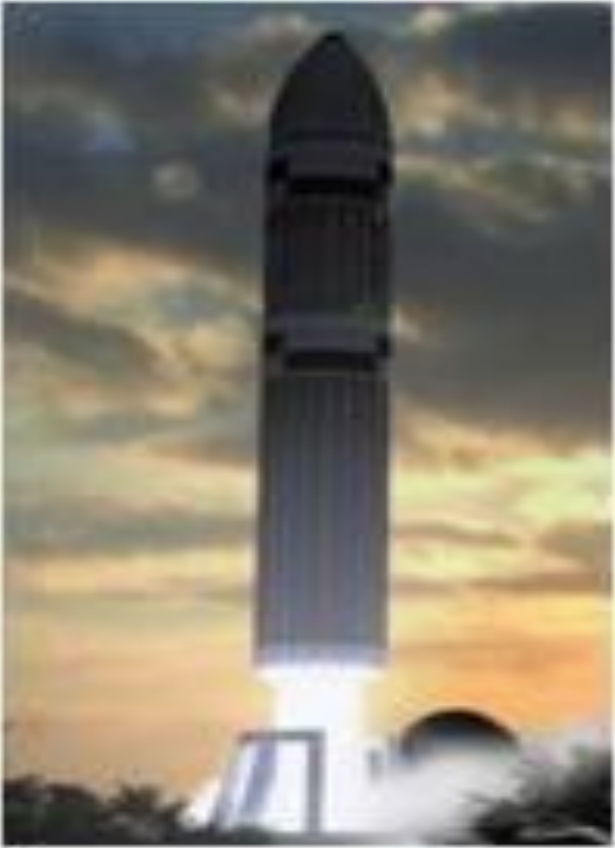
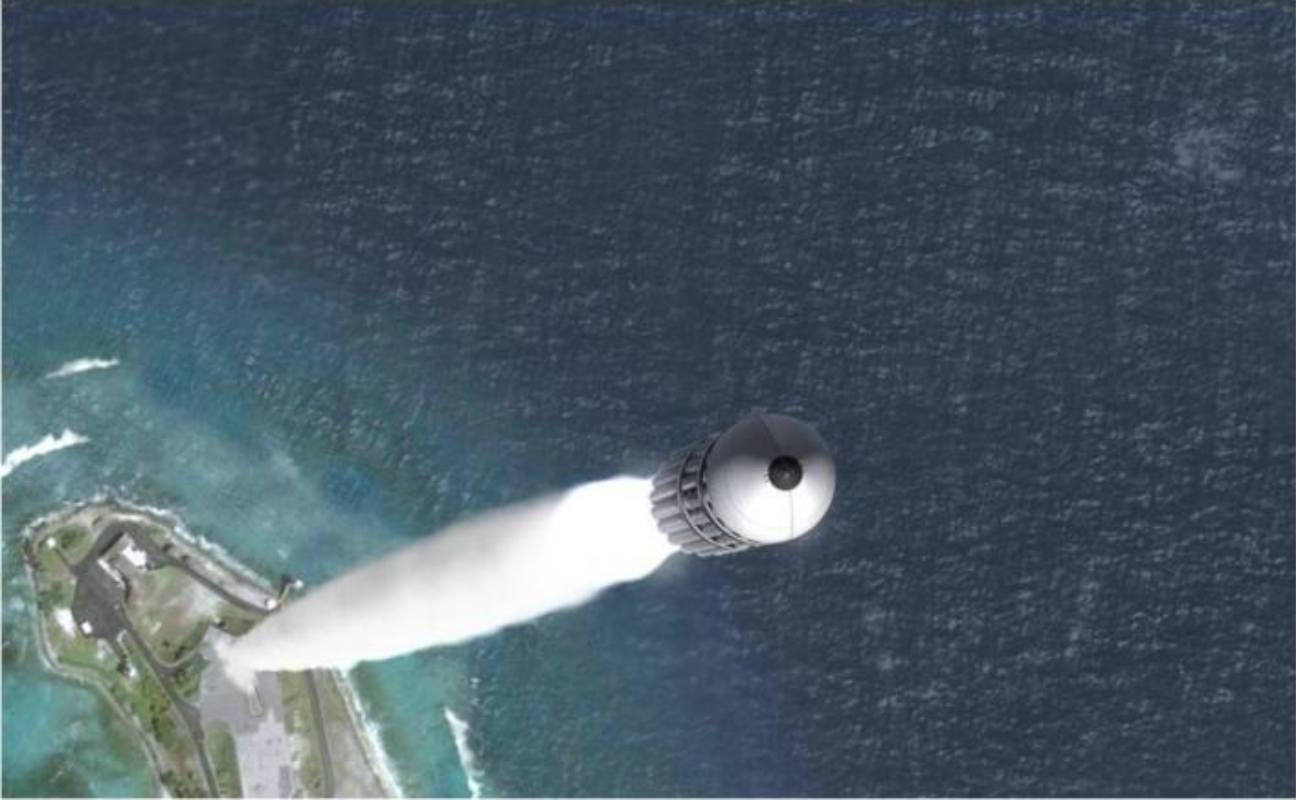
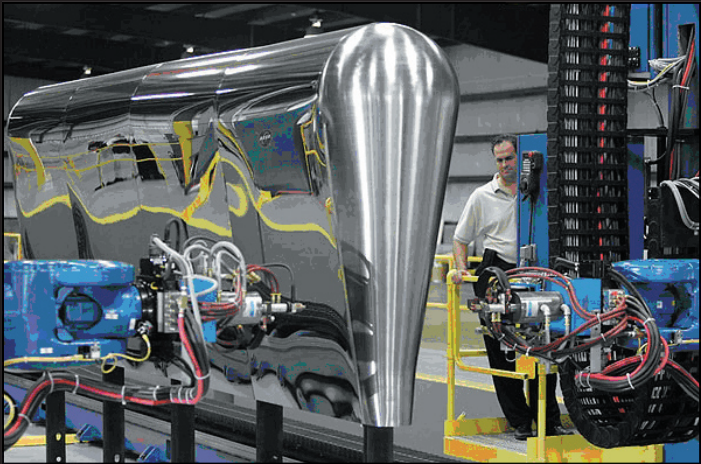
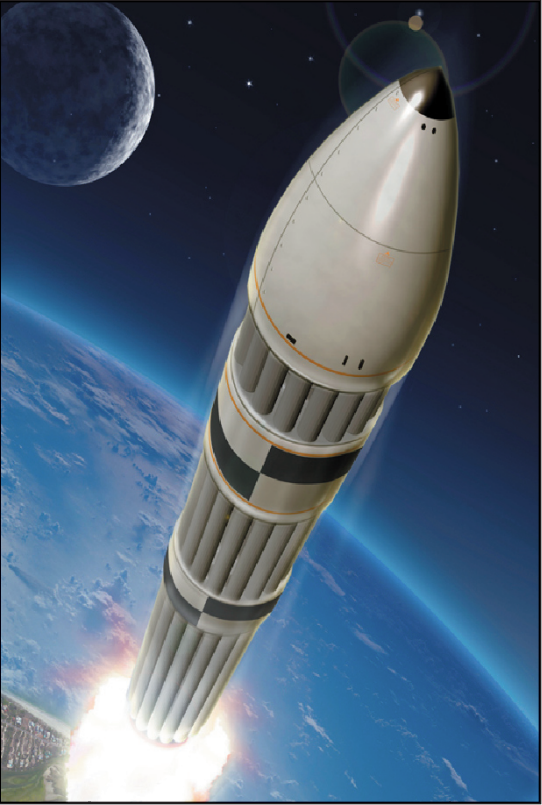
Images of RSLV-S [10, 15-17].
Congress allocated $4.7 million in 2004, $4 or $1 million in 2005, $1 million in 2006, $1.6 million in 2007, $1.6 million in 2008, for RSLV technical risk reduction [18-23]. In 2015 KTE demonstrated an additively manufactured catalytically ignited throttlable methalox pintle injector and engine, for potentially enabling RSLV and a pressure fed Mars vehicle [24, 5].


Igniter tests [24]
Soldier Warfighter Operationally Responsive Deployer For Space
In February 2012 SWORDS was selected by OSD as a new JCTD program of which BAE and Quantum submitted bids [25]. Quantum with KTE and Teledyne Brown Engineering as subcontractors was selected with KTE originating the vehicle concept and its leading technical design and TBE led manufacturing and supported engine tests. As of 2012 it was to be able to get 25 kg to a 750 km circular orbit at 28.5 degree inclination for 1 million USD in recurring costs, with an orbital test flight in 2014 [26, 15].
As of 2013 the price increased to 1.5 million USD, was delayed to a suborbital flight test in 2014, orbital test flight in 2015 though with perhaps an increased payload capacity to 85 kg [27].The 2012 design has 890 kN 1st stage propulsion, 392 kN 2nd stage propulsion, and 66 kN 3rd stage propulsion. The 2013 design has 1013 kN in vacuum 1st stage propulsion, 267 in vacuum 2nd stage propulsion, 69 kN in vacuum 3rd stage propulsion, both were 2.6 meters in diameter. RSLV-S images were also often shown next to SWORDS.
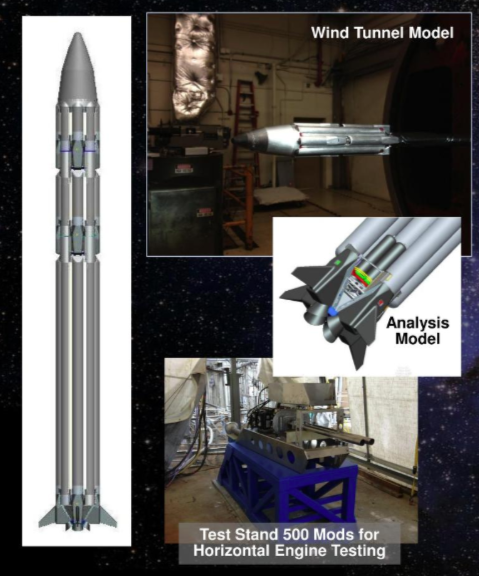
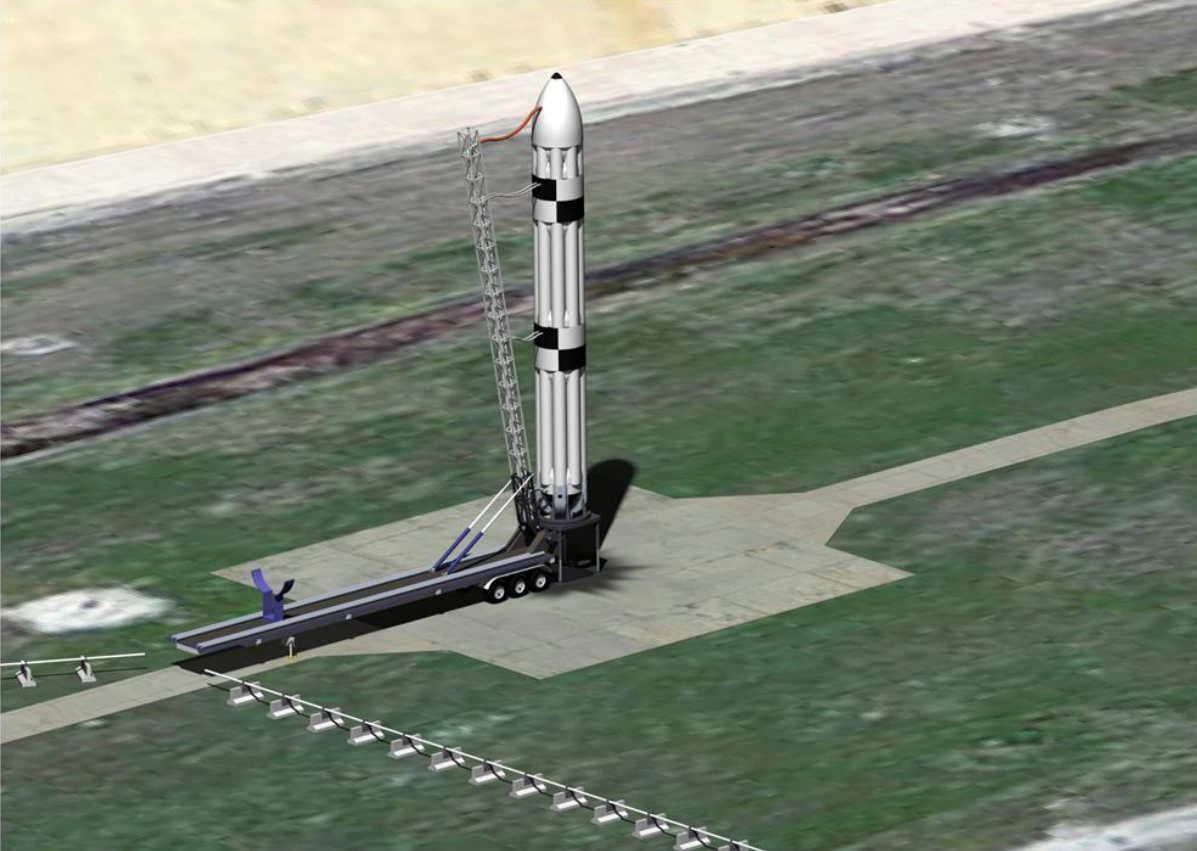

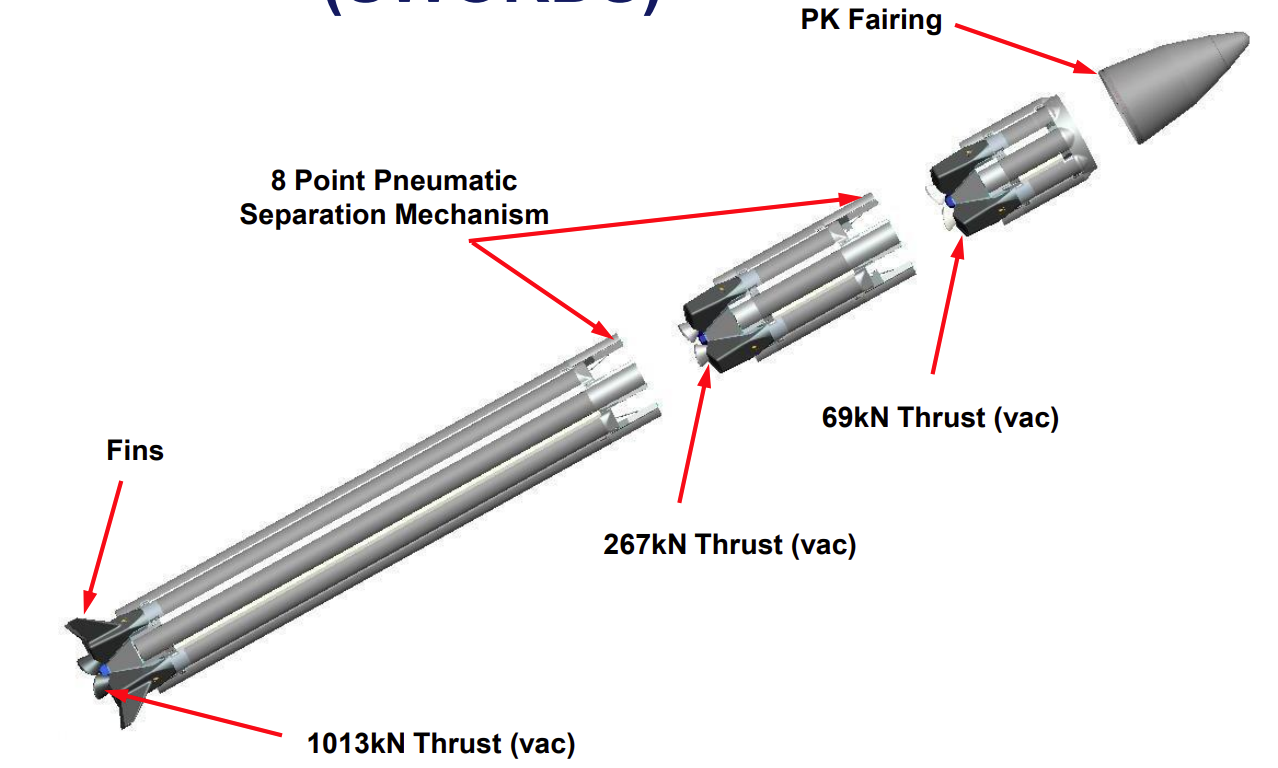


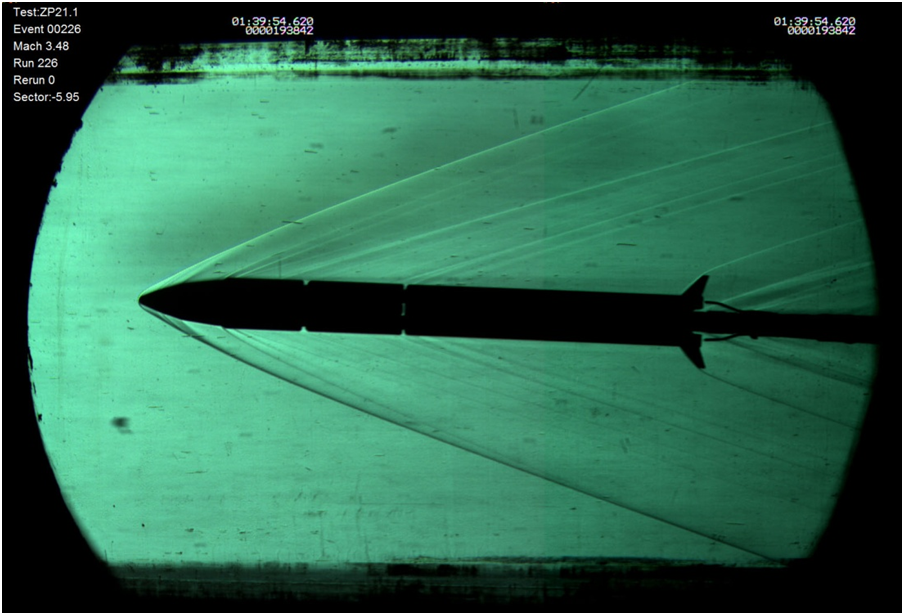
SWORDS renders and models [15, 28, 2, 29]
Like RSLV its engines were fed methalox by gas in the propellant tanks. Each stage had 4 engines canted inwards that used differential throttling for control, and may have had slight altitude compensating effects from said inwards cant making them act like a full spike nozzle. These engines had a unique ob-round cross section and asymmetrical canted nozzle which added difficulty in design, manufacturing, and testing [30, 31]. The 8 tanks on each stage were made of resistance spot welded stainless steel. Fairing development cost was to be minimized by use of surplus Peacekeeper ICBM fairings in the more mature designs. Over 272 wind tunnel tests of the vehicle design with and without fins at 1.3% scale [2]. The Langley and Ames Research Center led development of GNC systems. By March 2014 issues with cost effective propellant tank manufacturing led to the program to be descoped to only engine development, which terminated in September 2014 after demonstrating being able to build an engine for $60,000 of components of 267 kN [32].
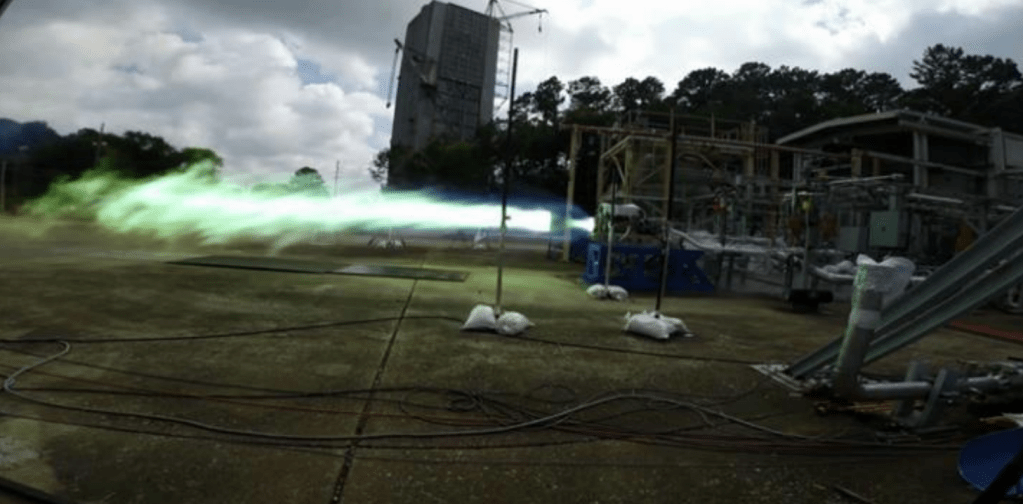
267 kN methalox engine test fire [25]
Aerospike Rocket Integration And Suborbital Experiment
In December 2019 the Air Force Research Laboratory or ARFL awarded ABL Space Systems (now Long Wall) and Invocon were awarded separate three year agreements for the Aerospike Rocket Integration and Suborbital Experiment or ARISE program. It would entail design, test, manufacture, and launch of a suborbital demonstrator vehicle using an aerospike nozzle with modular combustion chambers to demonstrate aerospike nozzle operation throughout open, transition, and closed wake modes for relevant speed and altitudes [33]. Invocon, teamed with KTE for experience with engines, pressurization, and structures and Troy7 for experience with GNC and vehicle operation (now owned by Yulista Holding) [34-36].

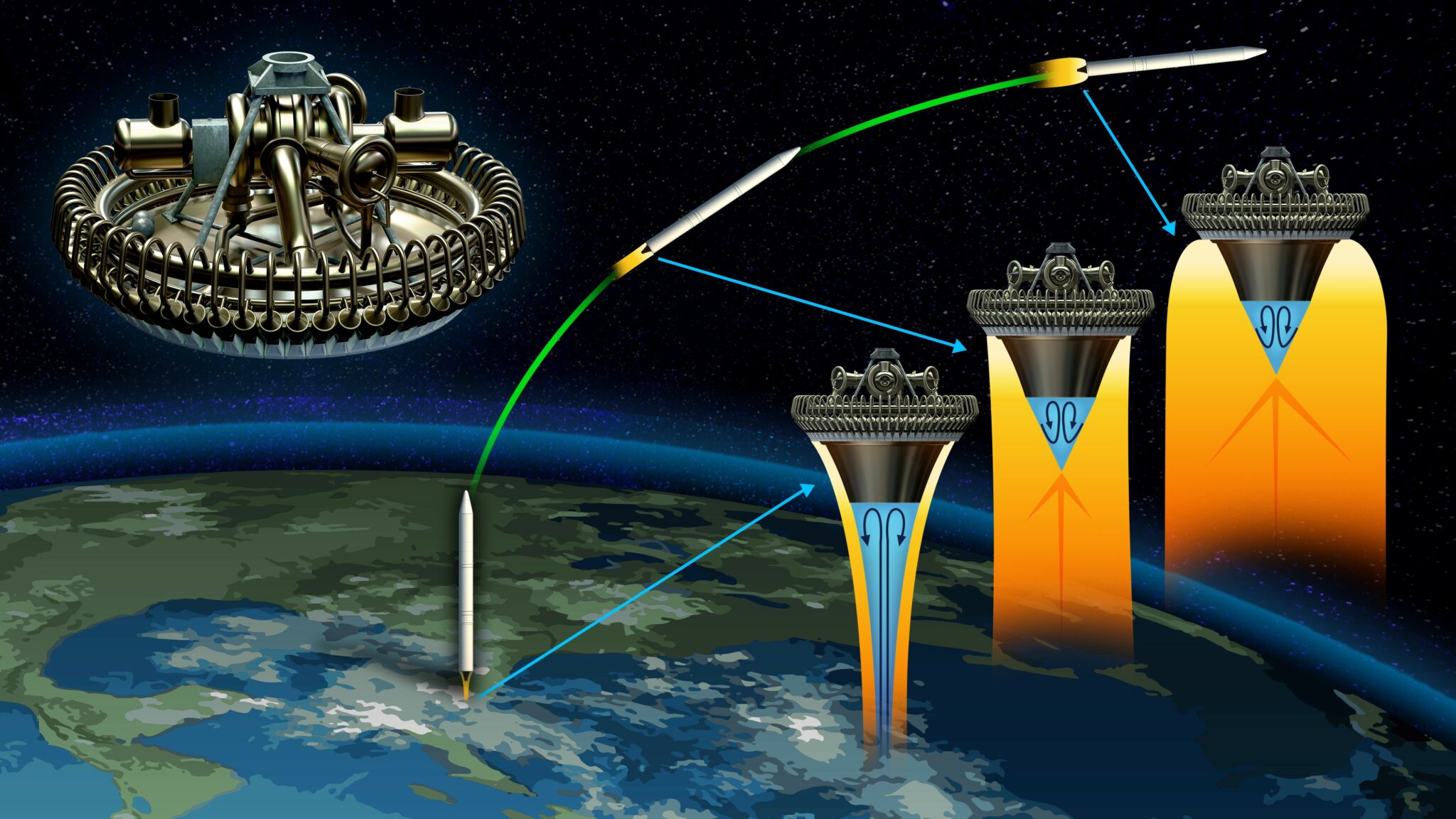
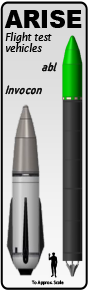
ARISE renders and model by [37, 38]
Incovon’s ARISE vehicle designated X-64 was to be 2.44 meters in diameter, 12 meters tall, and able to accommodate payloads up to 2.1 meters wide, 3.6 meters tall, and 3000 kg. The engine would be made of modular combustion chambers burning pump fed propellant with exhaust products fed into the outside of an annular aerospike nozzle and gas generator exhaust presumably exiting the center of the aerospike nozzle. The last public update on 2022 and the program ended sometime before July 11, 2025 due to the fact it was part of a 3 year contract with no comment on the first suborbital flight scheduled for 2022 [39].
Conclusion
MPLS, RSLV, SWORDS, and ARISE represent the evolution of vehicle concepts with design focused on affordability and responsiveness. Developed primarily by KT Engineering, these designs emphasized clustered combustion chambers, novel engine designs, and radially segmented tanks, with use of stainless steel structures and pressure fed propulsion.
Acknowledgments
The author would like to thank Dan Moser of Compositex Inc. for answering my question on ablative chambers relevant to SWORDS and Bruce Swanson of Invocon for informing that the ARISE program had finished.
References
- https://patents.google.com/patent/US6036144A/en?inventor=David+S.+Sisk
- http://www.kte-aerospace.com
- https://arc.aiaa.org/doi/10.2514/6.1974-1080
- https://www.linkedin.com/in/david-sisk-85088748/
- https://www.sbir.gov/portfolio/206983
- https://spacenews.com/darpa-and-air-force-select-falcon-phase-i-contractors/
- https://arc.aiaa.org/doi/10.2514/6.2008-4911
- https://www.nasaspaceflight.com/2006/11/rslv-progress-potential-vse-bonus/
- https://web.archive.org/web/20170322172237/http://kte-aerospace.com/PDFs/Milestone_LOX-LiquidMethaneEngineDev.pdf
- https://web.archive.org/web/20090730081338/http://marshallstar.msfc.nasa.gov/11-9-06.pdf
- https://web.archive.org/web/20100318221906/https://www.nasa.gov/centers/marshall/images/content/146999main_lox_203847_3000x2400.jpg
- https://archive.org/details/NASA_NTRS_Archive_20080047440
- https://archive.org/details/NASA_NTRS_Archive_20110016509
- https://netspublic.grc.nasa.gov/main/finalMultiuseEA.pdf
- https://web.archive.org/web/20121020024539/http://www.smdc.army.mil/FactSheets/SWORDS.pdf
- https://ndia.dtic.mil/wp-content/uploads/2013/ST/Wyatt.pdf
- https://www3.nasa.gov/centers/kennedy/pdf/593247main_sep30-2011.pdf
- https://spacenews.com/congress-adds-money-laser-warning-launch-efforts/
- https://archive.org/details/us_congress_108/congressional-record-2003-pt17
- https://archive.org/details/us_congress_109/congressional-record-2005-pt22
- https://archive.org/details/us_congress_109/congressional-record-2006-pt14
- https://archive.org/details/us_congress_110/congressional-record-2007-pt21
- https://int.nyt.com/data/int-shared/nytdocs/docs/132/132.pdf
- https://techport.nasa.gov/projects/33921
- https://digitalcommons.usu.edu/cgi/viewcontent.cgi?article=3349&context=smallsat
- https://www.thespacereview.com/article/2197/1
- https://web.archive.org/web/20140331094252/http://smdsymposium.org/wp-content/uploads/2013/09/Rich-White-presentation.pdf
- https://archive.org/details/NASA_NTRS_Archive_20140010096/page/n27
- https://web.archive.org/web/20150919202423/http://gcd.larc.nasa.gov/wp-content/uploads/2013/05/Schlieren.png
- https://ntrs.nasa.gov/api/citations/20160008028/downloads/20160008028.pdf
- personal communications with Dan Moser
- https://archive.org/details/DTIC_AD1010607/page/18/
- https://afresearchlab.com/news/afrl-awards-agreements-under-aerospike-rocket-integration-and-sub-orbital-experiment-arise-program/
- https://yulista.com/yhl-troy7-acquisition/
- https://www.invocon.com/wp-content/uploads/2020/07/20200527-ARISE_Announcement.pdf
- https://spacenews.com/abl-space-renamed-long-wall-as-it-shifts-focus-to-defense-market/
- https://afresearchlab.com/technology/arise-and-fly/
- https://www.invocon.com/news-2020/
- personal communication with Bruce Swanson
 Fuzzy Aerospace


Leave a comment